The Healthcare Staffing Crisis is Real & Here's Where AI Actually Helps
August 07, 2026By 2026, the healthcare industry could be short more than three million workers.
Not three million clerical roles. Three million trained people needed to care for patients, manage facilities, and keep operations running. At the same time, the US population is aging, hospitals are being built faster than staff can be trained, and the people who do show up for the job are spending too much of their day on spreadsheets.
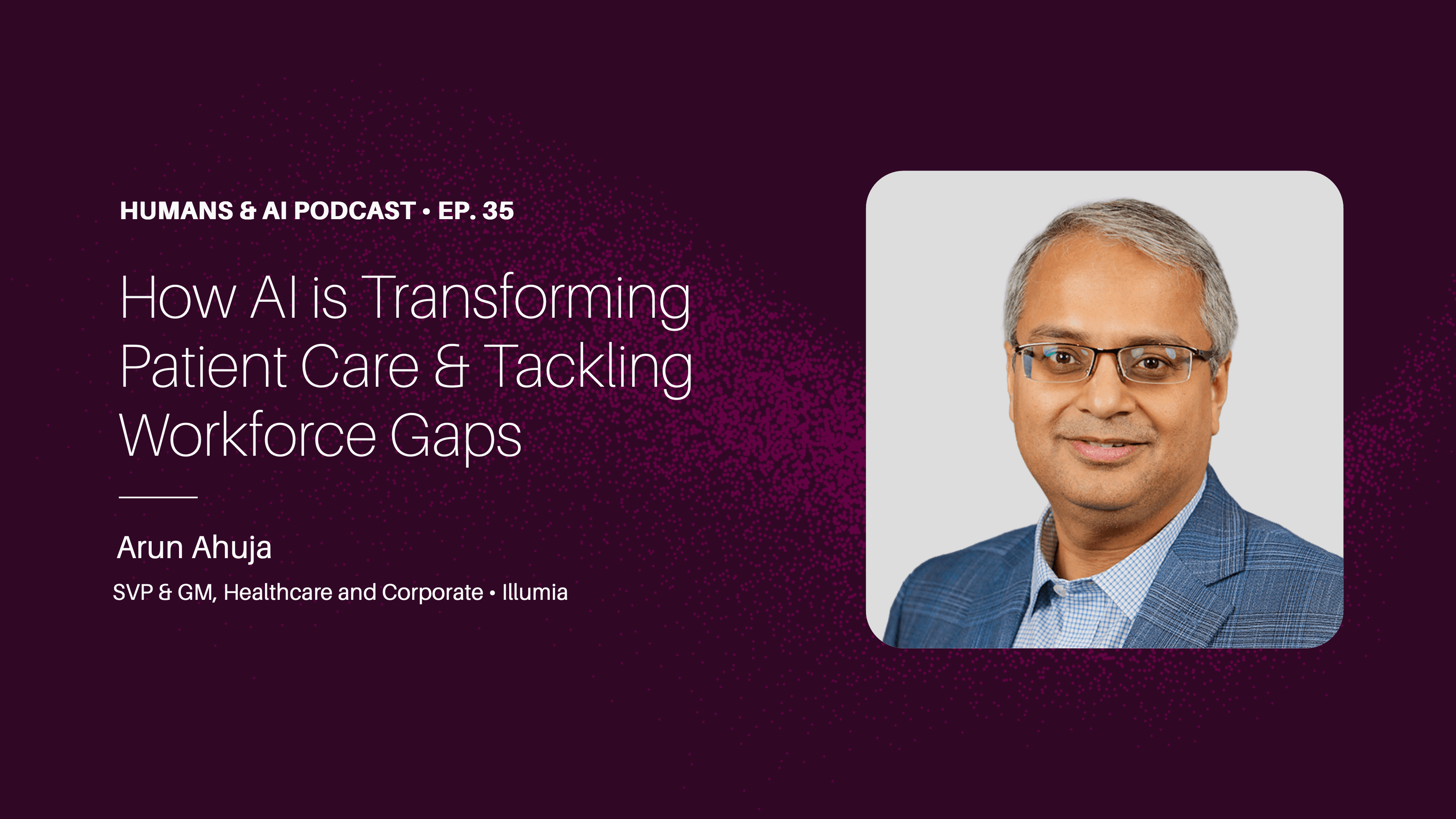
Arun Ahuja, Senior Vice President and General Manager of Healthcare and Corporate at Illumia, joined the Humans and AI podcast to talk about where that pressure is coming from, what technology companies can offer as trusted technology partners to healthcare operators, and what responsible AI in healthcare actually looks like when patient safety is always the first consideration.
The problem isn't motivation, It's time
Arun describes the healthcare staffing challenge with a clarity that reframes the conversation. The people entering healthcare aren't lacking commitment. They go in with a genuine desire to care for patients. What gets in the way is the sheer volume of manual, repetitive work that fills their days before they can do that:
“They are spending more of their time on tedious tasks, balancing reports, manually updating spreadsheets, which takes them away from doing exactly what they really wanted to do, which is actually service those patients and those people."
Digital transformation in healthcare is about giving caregivers back the hours the administrative layer is consuming. This is important to emphasize because it changes how technology gets introduced, explained, and ultimately adopted.
DoorDash, but for hospital patients
One of the clearest examples Arun shared is a patient ordering application his team developed that lets patients choose their own meals from their room. The concept sounds simple. The execution is anything but.
The app doesn't just surface a generic menu. It filters options in real time based on each patient's specific dietary requirements. A patient on a liquid-only diet sees only what they're permitted to order. No rejected requests, no frustrated calls to the nursing station, no patient feeling like their situation wasn't considered. Patient data is handled securely throughout, so clients can deploy with confidence:
“We're always thinking of how do we make the solution that we build very personal for the patient and make sure that they are feeling respected, that we know them and that we're serving them with what their needs are."
The feedback, passed back through clients who share patient stories, consistently reflects one thing: people who are sick and confined to a hospital room notice when they're treated with that level of dignity. And the staff notices when those moments don't require their intervention:
“It’s very heartening to see that and be proud that we’re part of that experience, that we’re helping them in that experience with their patients."
Patient safety isn't a constraint on AI. It's the starting point.
Ask Arun where responsible AI begins in healthcare and the answer is immediate: patient safety. Not efficiency. Not cost reduction. Not automation rates. Patient safety.
“The number one priority for any healthcare organization is around patient safety. So we embrace that as the number one goal for us. And how do we build any solution, how do we build AI capabilities, we always coach our clients and operators with that mindset."
That principle shapes a specific design philosophy: keep humans in the loop. AI in healthcare solutions must be built to surface recommendations, flag patterns, and put better information in front of the people making decisions, not to replace the decision making itself. The goal with AI is to make the human judgment more informed, not to eliminate it.
Part of how that trust is built is through the expertise Illumia brings to the table. Arun’s team includes registered dietitians who have worked in clinical settings, bringing lived expertise in nutrition and patient care directly into how solutions are designed. That cross-functional approach, engineers and clinicians building together, is what turns good intentions into products that work in the real world.
Arun is candid that even he experiences the tension. There are moments where AI feels transformative and moments where a hallucination makes clear how much still needs to go right before the technology earns deeper trust in high-stakes environments. That honesty is part of what responsible deployment looks like.
Only 10% of the world is using AI. That's the opportunity.
One of the more striking observations Arun shared wasn't about healthcare specifically. It was about scale. ChatGPT has somewhere between 500 and 700 million users worldwide. That sounds enormous until you do the math:
“That is really one tenth of the world population. So only ten percent of the world population is using that most famous AI tool out there in the world right now. There's a great bunch of population that has not yet been exposed to it."
For healthcare, that gap represents both a challenge and an obligation. The communities with the least access to AI-assisted tools are often the ones with the greatest need for what those tools can do. As leaders in the space think about where to direct their focus, expanding access, not just deepening it for those who already have it, has to be part of the answer.
Advice for anyone considering a career in healthcare technology
Arun came to healthcare from financial services and electronic engineering, neither an obvious path. His advice to people considering the space reflects that unconventional route:
“Healthcare is a great area. We have a very distinct opportunity to help people who are in the most need. It's exciting times, and you have the opportunity to actually make a change. And it doesn't have to mean being a doctor or a nurse. You don't need a medical degree to serve in the healthcare space."
The work of building technology that makes care more personal, more efficient, and safer for patients is meaningful in a way that cuts across disciplines. Engineers, product leaders, data scientists, and marketers all have a role. The entry point is a belief that the problems are worth solving.
---
Listen to the full episode here or wherever you get your podcasts!
Want to learn how Illumia is helping healthcare operators improve patient experiences through technology?
Speak to an Expert
Speak to an Expert